We’re being robbed of the benefits of human ingenuity
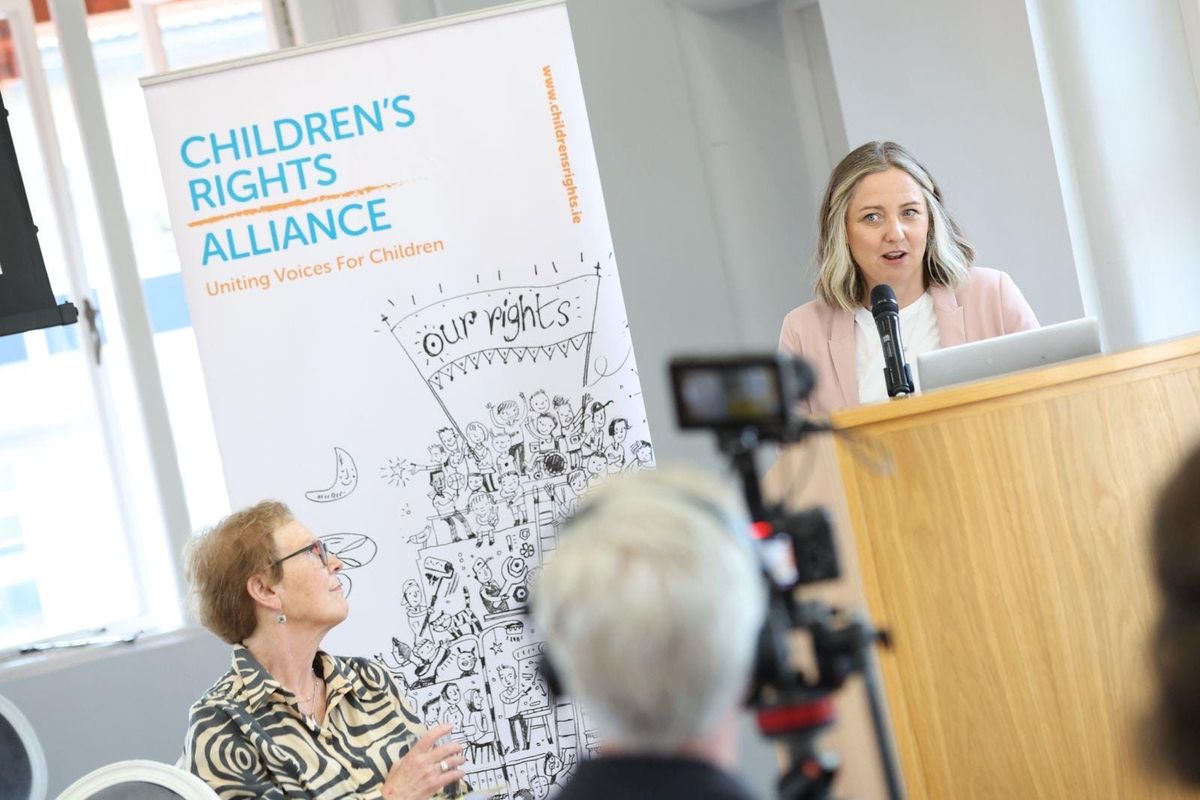
I gave a keynote today at an event on “AI and Accountability” hosted by the Children’s Rights Alliance, and I used it to untangle two ideas; that we can love tech while also being deeply enraged by the industry that has made every app we love an extractive hellhole; and that on AI, our political leaders are failing to separate tech from the industry that has captured it, while falling for the myth of “being left behind”. I’ll write it up properly soon, but someone asked for my speaking notes so publishing them here.
My daughter was born in the pandemic lockdowns, when my phone was my window to the world. As someone who loves technology, but has spent a decade and a half working on it, I felt confronted with tradeoffs that felt really unfair.
She didn’t sleep, and I wanted to use those sleep tracking and leap tracking apps; but why did I have to give all of her sensitive private information to use them, without knowing what would be done with it?
My daughter is now finishing Junior Infants and I would have loved to be able to tick the box on the forms to allow photos of her on her school tour or at Lego club to be published on the website.
But I won’t.
I know that last month, in the UK, photos from a school were taken, and an AI model was used to generate CSAM with fake versions of those children in it, and the school was then subjected to blackmail threats using the abusive images.
So my daughter's beautiful little face is only ever a blur of pixels in public.
When I look ahead, the tradeoffs don't seem to get much better - I’d love her to be able to call me when she gets off the tram, or to look up the cinema times on her own device when she is bigger.
But I know that if things continue as they are, this will come with too many risks and tradeoffs. Right now I honestly don’t know how I will cope with her FOMO if I don’t let her do the “normal thing” and get a phone.
And here is the hardest part; it - tech - didn’t have to be this way.
I am a technology enthusiast - a data nerd - but - I am a technology industry pessimist.
And I actually think the world pessimist is too light, because it doesn’t capture two things;
One is the cynicism I have at this industry that has unleashed so many types of harm on our societies. At every turn, apps and products have chosen extraction, and have bypassed both the laws and even the basic human rights principles that we have spent hundreds of years constructing.
There was a very good reason we built these legal and human rights frameworks.
And the other thing is that I feel like we are being robbed of something.
Enormously useful technology is degraded in both its usefulness and its safety, due to decisions made to extract maximum money from us.
We know what these decisions were, in the social media age at least; they were to have an ad based business model that incentivised addictive design, mass data collection, and algorithms that push content that makes us sad or mad but that keeps us looking at those ads.
I feel like corporate leadership are robbing us daily of the enormous potential of technology.
And more than that, they are robbing us of the potential of human ingenuity.
And it is happening again with AI.
Because; the tech itself is being created by our best technical minds, and it could solve so many problems.
But too often it feels like any benefits come with too many tradeoffs.
We are left feeling cheated, that the value of an app we signed up for is dwindling and diminishing as the costs mount over time.
And when we turn around to look to go somewhere else, the alternatives aren’t there.
I was on the radio recently and a listener text the show to ask a question; their friend is feeding every medical letter that comes through the door into a chat bot; is that a good idea they wanted to know?
And I want to live in a world where I can say to that person - Yes! Absolutely! If that is what you want, you want to use a tool to translate a technical document while you wait for your doctor to give you the full picture. Go for it.
But we don’t live in that world.
These tools are not being built in ways that serve us, or that at a basic level protect things like our privacy.
A lawyer in the UK, in fact, lost client privilege recently because she fed her notes into a chat bot.
The courts consider these systems to be so porous so not privacy safe, that they deemed what she did as equal to her publishing confidential notes on the internet.
Tools are also not being built in ways that put our human rights at their centre; how else do we end up with a mass released image generation tool that synthesizes non-consensual sexual imagery of women and children? The so-called “nudification apps”.
This is not some quirk of who happened to end up leading the major tech companies, as much as I would like to lay all the blame at the feet of an Elon or a Mark.
It is a specific set of market conditions, an economic system, that we - and decades of lax political leadership - have let be created that means that only the Marks and Elons and the Jeffs come out on top and capture human inventiveness.
What do I mean by market conditions?
In the technology marketplace, the winner takes all.
If you want to build a successful tech company; you have to grow and to dominate - you have to be Google, Facebook, or Amazon, not Ask Geeves, Bebo or Pets.com.
If you want to get ahead in tech world, you have to reach a scale where you have network effects and where you capture everything - you have to reach monopoly status.
You have to stay ahead longer than your rivals; or you simply get acquired by the dominant player - like Instagram and WhatsApp who were bought by Facebook.
That or you whither.
To be dominant, the likes of Facebook and Google have to lose money for long periods of time - in Amazon’s case, for a decade - while undercutting and killing competitors.
To cashflow that, you need to promise your investors that once you have your market dominance, you will extract limitless profits from users trapped in your ecosystem.
It is not enough to make a profit; that investor - venture capital - they are making 10 bets, knowing 9 will fail. The one that wins has to win huge.
That is why your delivery app used to offer you €10 off your order, back when they were bankrolled by Venture Capital. And it is why you now see fees piled on top of fees, on both you and the restaurant.
AI is repeating this trend, and supercharging it.
Those 1990s start-ups that turned into tech giants really were able to start in garages and dorm rooms, before bringing in that investment that allowed them to hang on until the competition fell away.
The barrier to entry of building an AI model is different; it is in the hundreds billions of dollars.
Let me give you some numbers; Bloomberg estimates that the big data centre firms are spending $750 BILLION this year alone; McKinsey estimates that by 2030, that number will be $7 trillion.
We hear a lot about AI SMEs and start-ups, and some of the deregulation discourse centres them, but the reality is that only the biggest players will make it to the top of the food chain; smaller companies are going to be acquired, or will be customers of the bigger AI firms.
There are three main ongoing input costs in AI; compute, energy, and data.
The compute is the chips that make up the data centres; these are in short supply and going for extraordinary sums of money.
The energy is what fuels those data centres. This is the electricity they use.
And then there is the data.
By data we mean the entire history of human knowledge production and creation, whole libraries of books, movie, every twitter post, cartoon, google search, newspaper article, YouTube videos, Facebook photo, reddit query, blog post, painting, the birthday e-Card you sent a decade ago, xRay scans, academic journal article, photo on a school website and - we must imagine - our entries into baby apps;
It is all of what human minds have ever produced, and it has been gathered and fed into AI models to create these tools.
Someone noted to me recently that the AI industry has decided that of these 3 inputs it is only willing to pay for two - the compute and the energy - but not the sum total of human knowledge. That, for the most part, it just took. {That would be Rosa Curling at Foxglove}.
In practical terms, what does this all mean?
It means, for a start, that we need a step change in how we think about our data.
We have come around to the idea that our data is used to market to us, we now need to update that thinking so that we factor in how our data - our content, photos, emails, voices etc. - how it is and could be used to create AI tools. And how it can be misused by those tools too.
We already discussed the idea that kids photos online can now be used to generate CSAM; our voices can also being copied to place fraudulent calls claiming we’re in trouble and need money sent.
In the workplace this can mean - as it does now for Meta employees - that data on every mouse click you make is being used to train the tool that will replace you.
In my work, I am thinking about what happens when I write for the Irish Times.
The Times pays me to write for them, and then Claude, ChatGPT or Google take it, summarize it, and then give that back to the person using the app.
The Times doesn’t get the traffic and the ad revenue - and they don’t build the relationship with the reader that can lead to a paid subscription.
If trends continue as they are, how are they meant to keep paying their writers? How do we ensure that journalism has a viable business model?
We need to start thinking about what this means for how we manage our own data, and for how it is governed, for what privacy can mean in 2026.
I think there are also questions about how we understand the value of our data, and who benefits from it in a new AI data economy we don’t yet fully understand.
I think there are things that we can do at a community level too; I agree with the Children’s Rights Alliance that banning children from social media, for example, is likely to be both ineffective and fail to deal with the root cause.
But I do think that we can take back more agency; schools and friend groups are agreeing collectively to delay smart phones, trying to reduce some of the FOMO pressure that is on kids if their parents are the lone holdouts.
I also think at a community level we need to think about freedom from technology, or or the “play based childhood” - as an equal right, so it doesn’t become a luxury and something that further entrenches social and economic divides.
But the truth is that we aren’t going to get to enjoy the kind of technology world that we want from individual or community actions.
The scale of the issue we are dealing with here is at a political level.
And where I would like to see things start is at the level of a political vision for what kind of tech world we want; and not to pick on social media bans, but they really do show this lack the scale of political vision that we need.
When I say political vision, I look to how we made great progress in other areas.
I think of pollution and the precautionary principle; an idea that shifted how we think about company’s responsibilities to our environment; the idea that a business had to presume something was harmful until proven otherwise.
You didn’t wait for fish to die from your factory’s waste being dumped in the river, you checked it was safe before you did.
I also think about DNA sequencing. In the late 90s, it became apparent that technology would allow us to sequence the entire human genome, an invaluable piece of intellectual property that could unlock whole new areas of science and medicine.
A private company set out to try to do this task first; so that it could copyright and “own” the code on which human life is written, and profit from licensing it to anyone who wanted to use it.
The Welcome Trust, a UK foundation, decided to beat them to it, to get there first and to then make this knowledge open to all science, as a public good. They teamed up with the US Gov to do it, and they won.
Because of this vision - it was called the Human Genome Project - we have a wealth of new drugs and treatments for everything from MS to Alzheimer's to cancer - a 2021 study found that two thirds of all new drugs were built on this freely available data.
I am not saying that either of these are fully analogous to AI, but to me they speak to this notion of ideas based leadership and vision for how things could be.
So what if instead of the policy question being - how does AI increase productivity; we ask questions like - how can we ensure that this feat of human ingenuity is harnessed for human benefit?
So what needs to happen now?
I would like our elected representatives to start looking at this issue as one of corporate power, of the state’s responsibility to ensure that products in our economies are designed safely, that these companies adhere to our laws, and incorporate human rights principles into their product design, their business models, and how they operate.
To do this our political leaders will need to separate out the technology from the industry.
There is a very strong story being told about how AI will fix our economic problems - AI is often spoken about as if it were some sort of unstoppable force of nature, as a new industrial revolution.
I feel like our political leaders have been sold an idea that less regulation is needed, not more; this despite all the evidence from the last 2 decades of tech companies running amok over our laws, our norms and our values.
I was in Brussels recently - on a trip to meet with officials from the Parliament and the Commission ahead of the Irish Presidency - and the near constant refrain from everyone was “we are afraid of being left behind”.
The tone - honestly - would not have felt alien to anyone dealing with a pre-teen feeling left out because everyone else has an iPhone.
It felt like FOMO was driving decisions of monumental importance for how the next twenty to fifty years of our economy and society play out.
There is a genuine belief that AI will be a catch all solution for economic growth and productivity.
This has been the tenor of a relentless stream of marketing and lobbying by the industry - OpenAI - who own ChatGPT - to give an example - alone spent $6 billion just last year just on marketing.
It is worth remembering that this is a company that in the same year made a loss of $21 billion.
Because here is the thing. None of these companies make profit yet from their AI products.
This is the honeymoon phase, this is the €10 off your food delivery phase.
When I opened my Facebook account in 2007, there were no surveillance ads or slop optimised for user engagement.
This is where we are with AI.
We do not know how they will make money.
The business model that they will use to repay their investors is not clear, or at least is not being made clear to us. We do know that these investors will expect a return on that investment for the $7 trillion lent to build data centres.
What we need at this moment from our political leader is to feel like they have our backs, like in the face of these huge forces, they are on our side.
Instead it feels like fear of being left behind has taken over.
The AI Act, which isn’t even properly in force, is already about to be weakened through the EU deregulation or “simplification” agenda.
GDPR and data privacy are up next for review by Brussels, and the discussions are likely to fall under Ireland’s Presidency.
The tech industry is being a terrible steward of the human ingenuity it has captured.
And we are doing all of us a terrible disservice when we equate these two things; the technology and corporations who own it.