Three digital stories of the by-election: a media round up
There were three interesting tech adjacent stories during the campaign; betting via (relatively) new predictive markets, Generative AI answers missing the mark, and new spending data transparency.
There were three interesting tech stories during the campaign I wanted to pull together; betting via predictive markets, Gen AI's election sources and dodgy answers, and new spending data transparency.
Election betting on steroids
The rate of electoral "betting" on Polymarket became a talking point in the last week of the election.
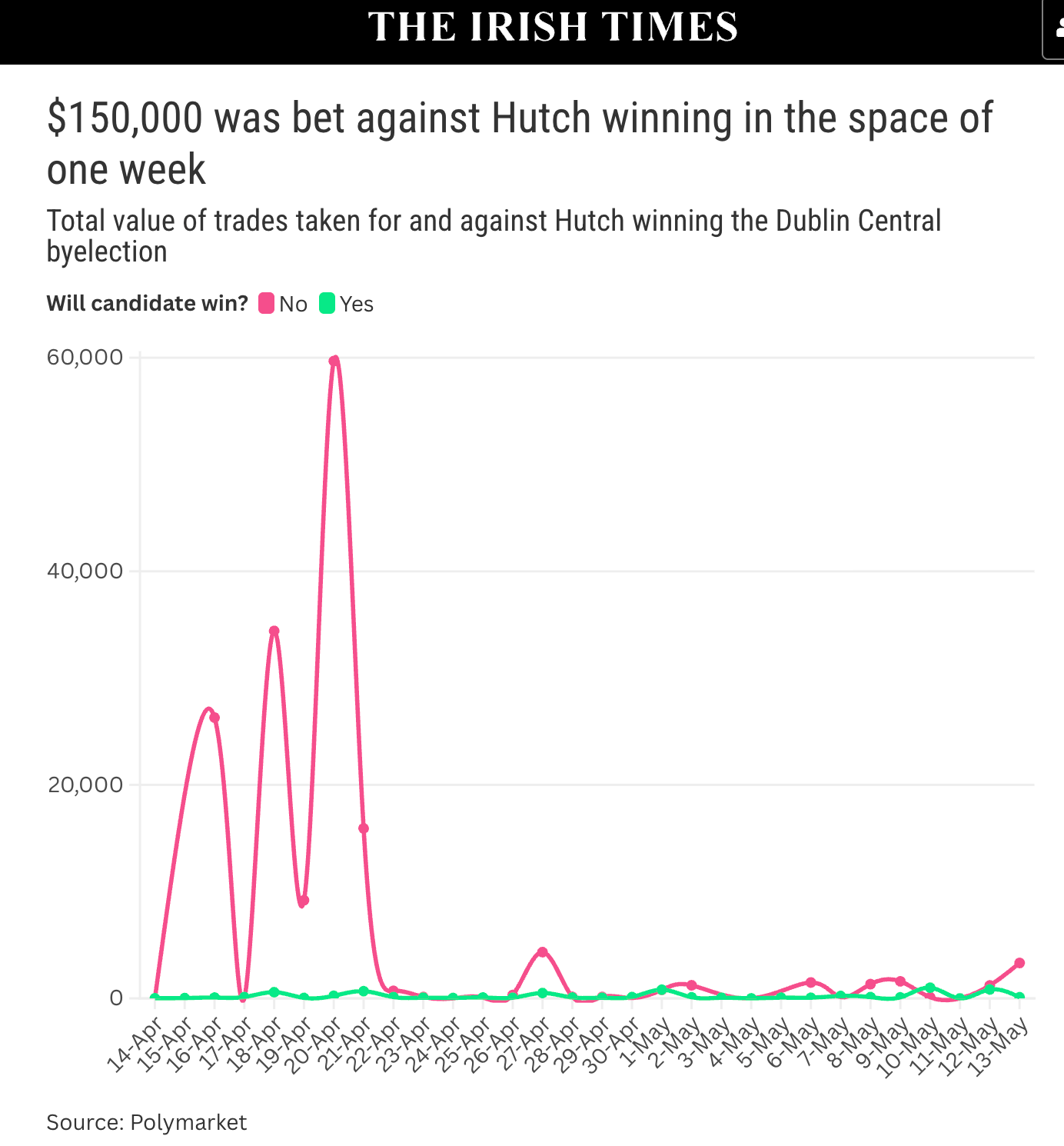
On Monday the Irish Times had an investigation by Rachel Lavin and Conor Gallagher into the almost $500,000 in trades made around the candidacy of Gerard Hutch in the by-election, many with suspicious patterns;
In many cases, individual crypto wallets were buying multiple shares larger than $500 in a “no” vote for Hutch to win. Within a few hours they were selling those same shares with little to no profit.
(You can check out the current situation yourself here.)
This type of trading, according to experts consulted, is a warning sign of potential "illicit financial activity", like money laundering. (The Times point out that there is no indication that the candidate themselves were involved.)
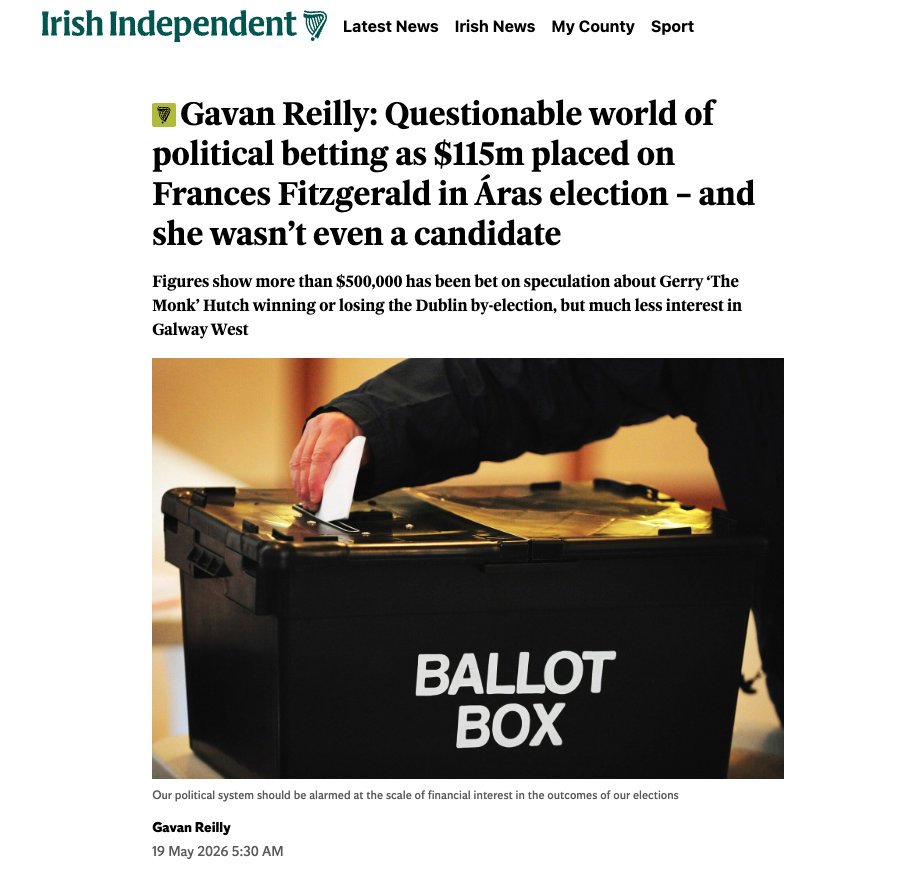
The plot thickened on Tuesday when Gavan Reilly had a piece in The Independent where he noted that €115 million of trades were made around the Frances Fitzgerald candidacy in last year's presidential election.
This prompted the Tánaiste to say that he had "grave concerns", as reported in The Examiner, and he has ordered an investigation; they quote him saying:
“I've asked my officials to now carry a deep dive analysis into this area, and to engage with the Department of Justice, An Garda Síochána, the Gambling Regulator, the Central Bank, and our EU partners, as we consider an appropriate policy response.”
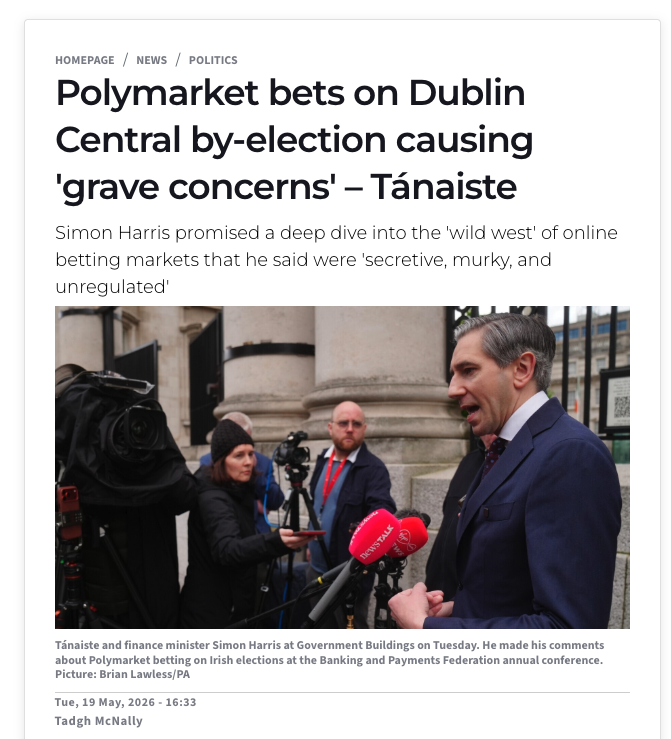
Why should we care? The concern is that predictive markets create incentives for people who have placed bets to try to change facts on the ground to win the bet; like the guy they found taking a hairdryer to the the weather station at Charles de Gaulle to win a bet.
A piece of well placed disinformation about a candidate has the potential to shift the polls one way or another, even temporarily, and make someone a big pile of money.
What chatbots got right and wrong
Some great new research out this week gives us an insight into chatbots told the curious about the elections.
UCD academics at the Connected Politics Lab (which I just heard existed), looked at three things; accurate of Gen AI answers; sources they used; and whether candidates were over or under represented in responses.
I was glad to see this done; a similar study in Scotland found that 34% of answers re their elections contained misinformation.
The Irish Times quoted the study's author in a piece yesterday:
“Broadly speaking, most of the answers were good,” said Dr James Cross, associate professor at UCD’s School of Politics and International Relations and director of the Connected Politics Lab. “But when it goes wrong, it goes really wrong.”
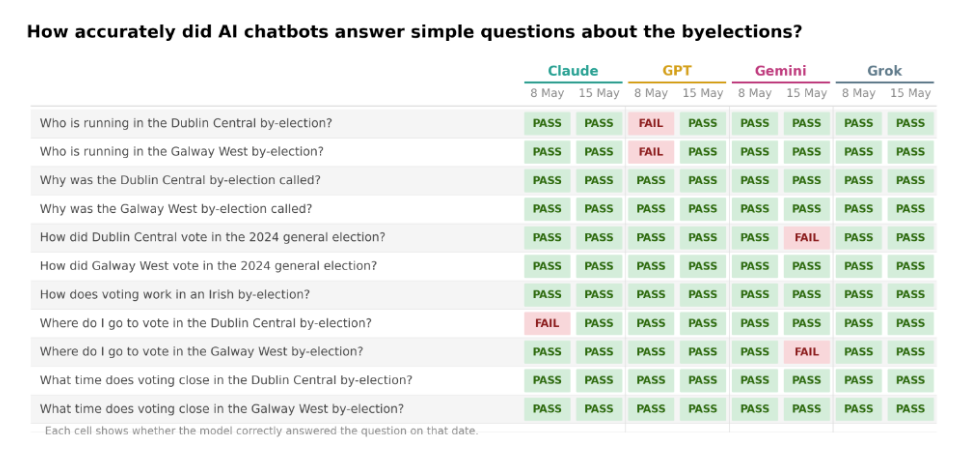
How wrong? Well the report found that:
ChatGPT left at least 6 names off the ballot when reporting who was running in both constituencies {and} Gemini, for instance, reported that Gerry Hutch won the fourth seat in the 2024 national election; in reality, he ranked fourth by first preference votes, but did not win a seat.
Two interesting notes on sources; the provision of good quality information online contributed to this overall state of not-too-badness:
Thanks to institutions like the Electoral Commission and citizensinformation.ie, reliable answers to these questions are easily accessible on the internet and can be surfaced using a quick web search.
This idea - that good info in the best way to counter bad - is something I talked about on Prime Time on Tuesday evening (we were discussing Slopaganda, watch back here).

The second thing on sources; the UCD research brokedown the sources chatbot quoted, which is below. Reliance on Gript - Gemini's joint highest used source - is something I also noted in the Farmer protests.
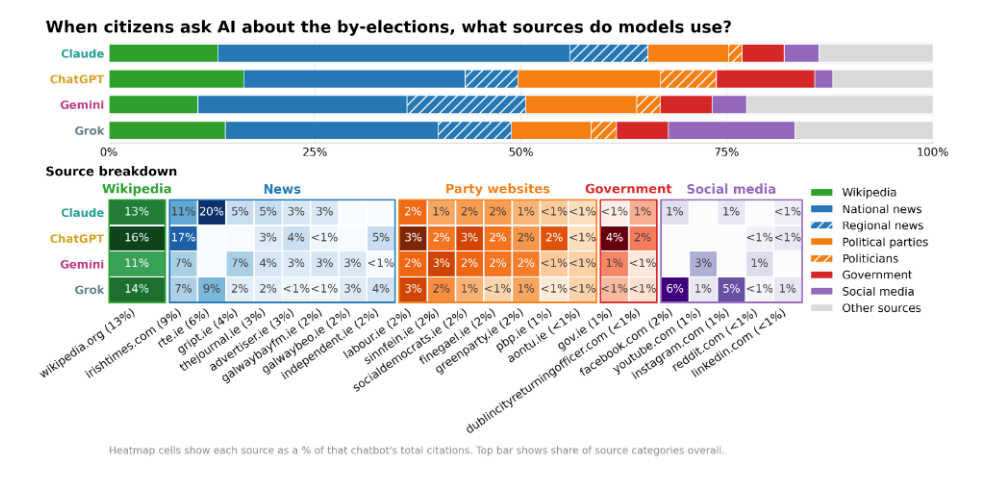
Why does this matter? A (different) Scottish survey found that "7% of respondents – rising to 13% of 16-24 year-olds and 10% of 25-34 year-olds – report using an AI chatbot to help them decide who to vote for."
Good news: new spending data in use
There is a 24 hour window every 2-3 years when normal people can be made to listen election spending transparency content, and Wednesday was that window.
I had an Op-Ed in the Irish Times that day where I share a lot of what I wrote about here last week on the new European ad transparency rules, the TTPA. I did take the moment to make a concrete ask on the Electoral Commission:
The Electoral Commission could produce templates and off-the-shelf tools that would give political parties and candidates easier ways to comply. Data standards should be introduced to make the numbers more accessible to journalists, who can then help the public to understand the forces that try to influence their vote.
 Liz Carolan
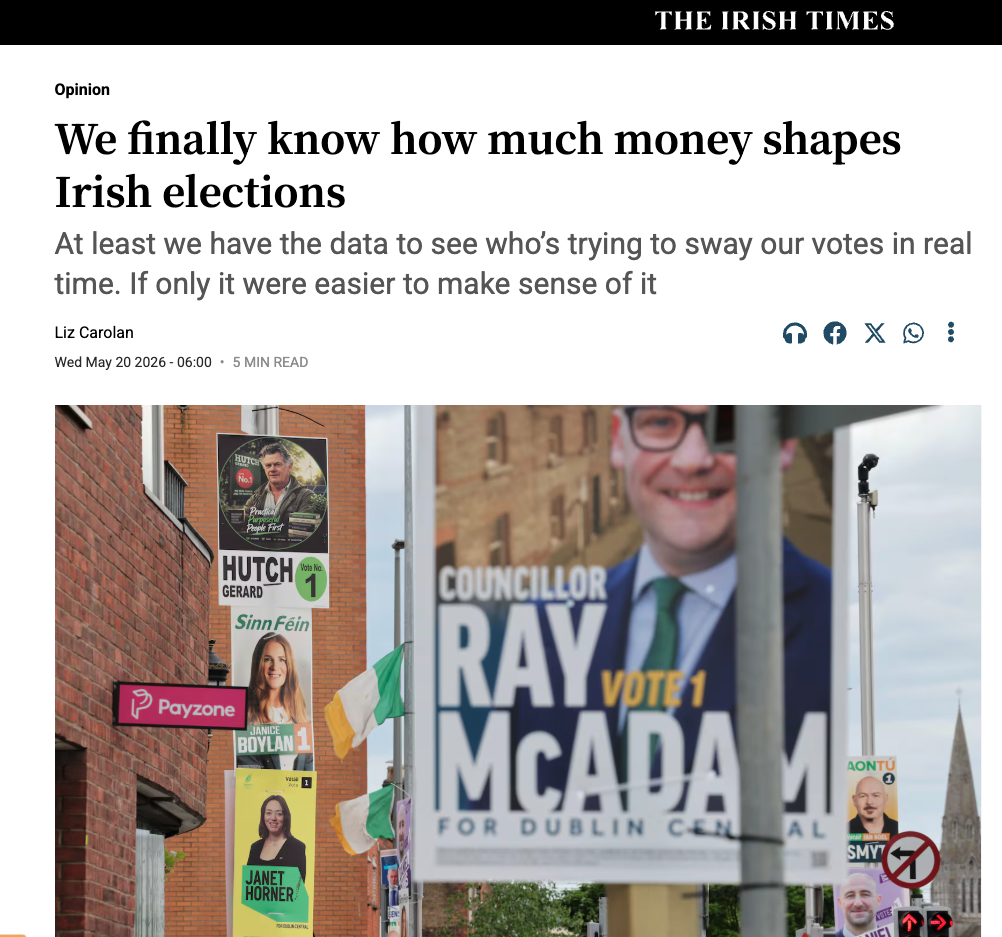
The Journal also used my data and did a great deep dive into what it means; the kind of reporting I hope we can see more of at the next election.
I then got to talk about it on Wednesday's lunchtime news, which you can listen to here.
We are going to make this work for the next election, by the way. If you're interested in helping make that happen - reach out.
Honourable mention: how Irish newsrooms are using AI
Not election related, but while I have your attention - do read the Dublin Inquirer's excellent long read on how both media orgs are actually using AI in their work flow. A lot of really practical insights, but I also liked that author Sam Tranum got this line in from their journalist survey:
Anything else to add, the survey asked? "Fuck AI, one of the respondents added.