Desperately seeking Unicorns: a report from inside the Brussels bubble
Companies reach Unicorn size due to sheer ruthlessness; of their business practices and of the US idea of capitalism.

Last week I traveled to Brussels as part of a delegation of Irish journalists. We were there ahead of Ireland's assumption of the presidency of the Council of the EU in July (I did an explainer on this for Tech Policy Press), invited by the institutions hoping to raise understanding of the EU among Irish media, and by proxy, the Irish public.
I came back not surprised that coverage of the EU is low, but also quite concerned about a myth that seems to have taken on cult status in that mid sized Belgian town.
Who do you call when you want to call Europe?
Figuring out who in Brussels to talk to, or to quote even, is hard. On purpose. Built in the still embering ashes of apocalyptic war, the institutions have in their DNA a single overriding principle; ensure that no power is ever concentrated in the hands of one person or group.
Let's say you meet an MEP - that sounds important - and they are on an important sounding committee.
But wait; there could be up to 90 MEPs on that committee, and there are 22 committees.
And these committees build compromises, which they then take to plenaries, where then they are one of 720 MEPs voting, who probably have to vote in line with their political grouping, and then compete with and / or make compromises the 7 other political groupings.
But at the end of this, they have made important law, right?
No. As best I can tell, the Parliament then makes a recommendation to the European Commission to think about a law.
Then a Commissioner takes over. OK they sound important. But wait they are one of 27, and the Commission also has 30,000 staff who all have important sounding jobs.
And then everything goes to the European Council anyway, the member state Governments, and even there and even if you are the German Chancellor, you are still just one of 27.
And anyway, it is all actually about relationships and formal processes were probably actually already decided somewhere else a long time ago so frankly, you're too late. But you wouldn't know that because you're not here.
Brussels is a sub-culture
I have taken courses in EU politics, looked at the text books and the "legislative trains", had people explain things to me over many a pint, sat in the buildings, and the main thing I have leant is that this system is impenetrable to anyone who hasn't dedicated years - and I mean years - to navigating and understanding it.
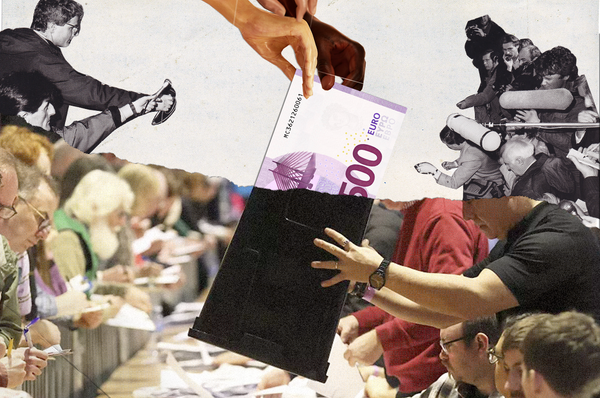
This, of course, causes problems. Firstly; this knowledge is for sale. If you have the endless billions that {cough} Big Tech has, you can buy in expertise that will tell you where, when and how to gain access to the pens that write the rules (quite literally, as reported by the journal).

You can figure out which small little process happening over there has the power to undercut the big shiny one that everyone else is trying to influence over here.
You can also craft both the problems the institutions think are important, and plant the ideas they have for how to solve them.
The second problem is that all of these processes and safeguards and compromises gloss over the fact that this is a fairly insular - in the meaning of inhabiting an island, not small minded! - community of people who obsess over the same things in the same bars and cafes and conference rooms, building along the way shared beliefs, accepted wisdom and in-group language. Like any other sub-culture.
The cult of Simplification
And these two forces were on full display last week around the cult of "Simplification". Everyone we met, even those sceptical of this de-regulation drive, seemed to accept as gospel the idea that complexity from Brussels is the barrier to EU competitiveness.
On the surface this seems fair, SMEs and farmers do seem to be swamped with forms. But scratch just a little below the surface and you see what the idea of competitiveness has come to mean; Unicorns, companies valued at over $1billion.

Stripe is mentioned a lot here; with Simplification, accepted wisdom goes, Stripe would have been headquartered in Limerick.
If the conclusion here was about capital markets - that it is easier for companies to raise money to scale in the US - I might let them at it.
But instead - no doubt driven by the influence machine in full force - sights have turned to the idea of gutting the framework of tech and other regulation that has been hard fought and won over the past decades, through expedited "omnibus" packages of rule cuts that will - let us be honest - mostly benefit big US tech firms.
How Unicorns grow
Let’s be perfectly clear, companies reach Unicorn size due to sheer ruthlessness, of their own business practices and of the US idea of capitalism.
Companies reach GDP-sized valuations because the US has complete disregard for anything other than corporate profit when it comes to tech regulation (personal data can be freely bought and sold, CSAM produced without sanction, anti-competitive mergers waved through); because employees can be sacked by logging them out of their accounts; elections auctioned to the highest bidder; healthcare used as a cudgel to retain staff; obscene wealth amassed and celebrated; the environment polluted and plundered.
The idea that a start-up founded in a box room in Lithuania or Limerick can reach Unicorn status is as mythical as the creature itself, grounded in some Gen X dreaminess about startups and rock bands started in garages.
Most “start-ups” in 2026 don’t actually dream of huge growth - or at least their investors don’t.
They dream of acquisition.
Acquisition by one of the big monopolies established in the early internet days when the web was open and real estate was up for the taking.
This is even more unlikely in the AI age, when scale of compute and of data is the only thing that matters. Even the mighty Open AI had to become a vassal state of Microsoft to access its compute power.
How will gutting privacy rules help Finnish companies compete with Google, when Google can index the entire web daily to feed its models, spend billions on compute power without any need for profit, and lean on politicians to get its way?
And yet guess who will actually benefit from gutting privacy rules?
A reminder that if you'd like to support our running costs, you can do so here (yes, using Stripe).